 |
| Quick Snapshot |
"Unsure which electrical switch best suits your outdoor gear needs? It’s more than just turning power on and off—it’s about safety, durability, and performance. Discover how the right switch prevents accidents, ensures reliability, and keeps your equipment safe, no matter the conditions."
Outdoor power equipment faces the harshest conditions—rain, dust, UV exposure, and constant vibrations. From wiring a lawn tractor accessory to upgrading a pressure washer control, selecting the right switch isn’t just about convenience; it’s about safety.
How can you ensure the switch you choose will stand the test of time? A reliable switch prevents accidental startups, blocks water intrusion, and reduces the risk of electrical hazards like shocks or fires. Visit your local electronic components shop to find switches that can endure the toughest conditions without compromising performance.
|
| Know the Real Hazards Outdoor Switches Face |
| Before selecting a switch for outdoor equipment, it's vital to understand the environmental factors that could compromise its performance. Outdoor switches are subjected to various conditions that can affect their longevity and safety. Let’s break down these hazards: |
-
Moisture and water jets: Outdoor equipment is often exposed to unpredictable weather conditions, from rainstorms to sprinkler systems. Water can seep into switches, causing electrical short circuits or rust buildup. A switch must be adequately sealed to prevent water from damaging internal components, especially when it's hit by high-pressure water during a washdown.
- Dust and debris: Outdoor conditions frequently expose switches to microscopic particles like soil residue, fine sawdust, and suspended pollen. These particles can accumulate inside switches, restricting their functionality and potentially causing them to overheat. Dust combines with moisture to form sludge, which can lead to corrosion, reducing the switch’s effectiveness over time.
- Vibration and shock: Vibrations from engines or sudden impacts from rough terrain can loosen switch components, leading to malfunction or failure. The switch must be designed to handle such physical stress, ensuring long-term durability and reliable operation, especially for equipment used in rugged conditions.
- UV exposure: Prolonged exposure to direct sunlight can degrade plastic casings, making them brittle. This not only affects the switch's appearance but can also compromise its integrity, allowing moisture or debris to enter. Choosing switches with UV-resistant housings ensures they withstand long hours in the sun without deteriorating.
- Corrosion: Exposure to harsh chemicals or salty air, particularly in coastal regions, accelerates corrosion. Switches that are not corrosion-resistant can quickly fail when metal parts begin to rust. Opt for switches made of corrosion-resistant materials to avoid safety hazards caused by rusted terminals.
- Temperature swings: Fluctuating temperatures can cause materials to expand and contract, potentially leading to cracks in switch enclosures or failure of internal connections. A switch must be able to function optimally in both cold mornings and high heat, maintaining its performance regardless of temperature extremes.
Your “best” switch is the one that’s matched to your environment—not the one with the most features on the box. |
| Start With the Use-Case: What Must the Switch Do? |
| When selecting a switch for outdoor equipment, define its role first. The safety requirements differ based on its function. Consider these key use-cases: |
- Emergency stop/rapid shutdown: This is the highest priority, ensuring the machine can be halted immediately in dangerous situations. A well-designed emergency stop prevents injury by swiftly disconnecting power.
- On/Off control: Essential for controlling power during normal operation. This switch needs to be reliable, with clear visual indicators of its status, preventing accidental startups or shutdowns.
- Interlock/prevention: This feature ensures that the machine won’t operate unless certain safety conditions are met. For example, it might allow the equipment to run only if the safety guard is in place or the user is seated.
- Disconnect/isolation: A crucial feature for maintenance, allowing operators to lock out the power supply during servicing. This guarantees safety when working on or near powered equipment.
- Mode selection: Common in multi-functional equipment, this switch lets the operator choose between modes like forward/reverse or different speed settings, ensuring precise control over operations.
A switch that’s perfect for “turn lights on” might be dangerously wrong for “stop a spinning blade.” |
| Understand IP vs NEMA: The Ratings That Actually Matter Outdoors |
| If you only remember one thing: outdoor switches must be rated for ingress and exposure—not just “looks sealed.” |
- IP Ratings (Ingress Protection)
IP ratings are a critical factor in selecting switches for outdoor equipment. These ratings, defined by IEC 60529, offer specific protection details:
-
First digit (0–6): Protection against solids (dust).
Second digit (0–9): Indicates the level of resistance to water and other liquids.
|
| ✓ Examples you’ll see often: |
- IP65: Completely sealed against dust and designed to withstand low-pressure water spray from all directions. Ideal for areas with occasional splashing or light rain.
- IP66: Provides stronger protection against powerful water jets, making it suitable for more aggressive conditions like washdowns or heavy rainfall.
- IP67: Offers dust-tight protection with the ability to withstand temporary submersion in water. Perfect for equipment used in environments prone to water exposure or flooding.
|
| Each IP rating helps determine how much moisture or dust a switch can safely handle, ensuring that the switch performs reliably in various outdoor conditions. |
| •NEMA Enclosure Types |
| NEMA types describe environmental protection for enclosures and are commonly used in North America. NEMA’s own guidance explains these “Types” and points to NEMA 250 for detailed definitions. |
| ✓ A few outdoor-relevant types: |
- NEMA 3R: Designed for protection against rain, sleet, and snow. Suitable for standard outdoor environments with occasional exposure to weather.
- NEMA 4/4X: Provides added protection against splashing and hose-directed water. The 4X variant also includes corrosion resistance, ideal for environments with frequent cleaning.
- NEMA 6/6P: These enclosures can withstand temporary (6) or prolonged (6P) submersion in water, making them ideal for equipment exposed to extreme wet conditions or briefly submerged.
- These ratings give you the confidence to select the right switch based on your specific environmental challenges.
|
| ✓ Rule of thumb: |
- Light weather exposure → consider IP65 / NEMA 3R
- Washdown, heavy spray, mud → IP66+ / NEMA 4 or 4X
- Flood risk / submersion scenarios → IP67 / NEMA 6 (or 6P)
|
| Match the Switch to the Electrical Load (This Is Where Safety Often Fails) |
| A switch isn’t “rated” just by voltage. The type of load matters even more outdoors because motors and inductive loads create arcing. |
| When selecting, confirm these specs on the datasheet: |
- Voltage type: AC and DC have different switching requirements. DC switches experience more arcing due to the continuous current flow, making DC-rated switches essential for DC-powered equipment.
- Current rating: Ensure the switch can handle the continuous current load without overheating. Choosing a switch with too low a current rating can cause early failure due to overheating.
- Inrush/starting current: Motors often draw multiple times their rated current during startup. Ensure the switch can handle this surge without damaging contacts, which would compromise performance.
- Inductive load rating/horsepower rating: Inductive loads, like motors and pumps, generate high inrush currents. A switch rated for such loads will minimize damage caused by high startup currents.
- Duty cycle: For equipment that requires frequent on/off cycles, choose a switch that can handle the stress of repeated operations without excessive wear or heat buildup.
- Safer design approach: If you’re controlling a motor or high-load accessory, use the switch to control a relay/contactor, and let the relay handle the heavy power switching. This reduces arcing in the hand-operated switch and improves longevity.
|
| Pick the Right Switch Style for Outdoor Power Equipment |
| Different switch types solve different safety problems. Here’s how to choose logically: |
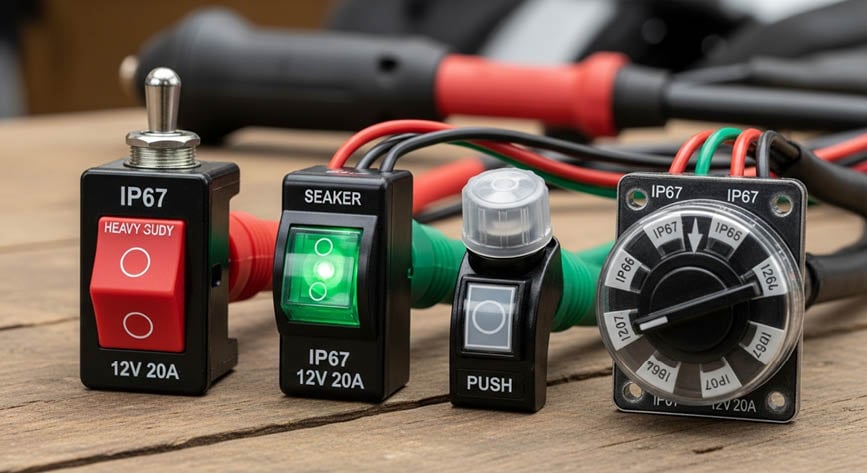
• Sealed Rocker or Toggle Switch (Best for Simple On/Off)
Rocker or toggle switches are ideal for basic on/off control, perfect for accessories like lights and auxiliary pumps. Look for models with sealed boots and gasketed panels to prevent water or dust ingress. If visibility is an issue, prefer illuminated versions, but ensure the indicator circuit is also rated for outdoor conditions to maintain reliability.
|
• Momentary Push Button (Best for Controlled Starts)
Momentary push buttons are perfect for initiating controlled starts in equipment powered by a relay or controller. These are safer than maintained ON switches since they require continuous pressure to keep the equipment running. Pair the push button with an interlock mechanism to prevent the machine from starting under unsafe conditions, further enhancing safety.
|
• Rotary Switch / Selector (Best for Modes)
Rotary switches are great for equipment with multiple modes, such as speed control or direction selection. Look for switches with clear detents and easily legible labels that won’t fade over time. Ensure the switch is built to withstand frequent use and harsh outdoor conditions, ensuring durability and consistent performance. |
• Key Switch (Best for Preventing Unauthorized Use)
Key switches are crucial for preventing unauthorized operation of equipment, especially high-risk machinery like generators. Look for switches that feature outdoor-rated cylinders and corrosion-resistant materials to ensure longevity and reliability. This prevents unauthorized or accidental activation, promoting safety and security when the equipment is not in use.
|
• Emergency Stop (E-Stop) Mushroom Switch (Best for Immediate Shutdown)
An emergency stop (E-stop) mushroom switch is a must-have for equipment that could pose significant safety hazards. Look for E-stop switches with mechanical latching and a deliberate reset mechanism. It’s essential to pair the switch with positive or direct-opening contacts, as specified in IEC 60947-5-5, ensuring safety in emergency situations by cutting off power instantly. |
• Dead-Man / Presence Switch (Best for Handheld or Walk-Behind Equipment)
Dead-man switches are vital for handheld or walk-behind equipment, ensuring that the equipment stops when the operator loses control or releases the switch. Look for designs that require continuous human action to keep the machine running. This automatic power cut-off feature provides an added layer of safety, making it ideal for high-risk scenarios. |
| Construction Details That Separate “Outdoor” From “Outdoor-Looking” |
| Outdoor equipment requires more than just functionality; it demands durability. Pay attention to construction details that ensure reliability and longevity in harsh conditions: |
- Seals and gaskets: Look for robust compression seals, not flimsy or decorative ones. Proper sealing prevents moisture, dirt, and dust from entering the switch, preserving its functionality in wet or dusty environments.
- Booted actuators: Rubber boots around toggles or pushbuttons provide an essential layer of protection against water, dirt, and dust. These boots safeguard internal components, extending the switch's life while maintaining its performance.
- Corrosion-resistant hardware: Switches exposed to the elements should feature stainless steel fasteners, plated springs, and protected terminals. These materials resist rust and degradation, even in salty or chemical-rich environments.
- UV-stable housing: UV-resistant materials prevent the switch’s housing from cracking, fading, or becoming brittle under prolonged sun exposure. This ensures that the switch remains durable and its labels stay readable over time.
- Contact material: Choose switches with superior contact materials. Higher-quality contacts resist oxidation and arcing, reducing wear and extending the switch's longevity.
- Cable entry protection: Proper cable entry protection, like glands and strain relief, ensures that cables remain securely in place and protected from water and debris. Avoid bare holes or makeshift solutions like silicone, which can break down over time.
|
| If a switch is labeled “weather-resistant” without an official IP or NEMA rating, treat this as a marketing claim until verified with proper testing. Trusting such claims without proof can lead to unexpected failures in harsh outdoor conditions. |
| Safety Features to Look For on the Datasheet |
| When safety is the goal, these features matter more than aesthetics: |
- Double-pole switching (DPST/DPDT): This feature allows the switch to isolate both lines, providing a safer disconnection in certain systems, especially in applications that require isolating live components to ensure operator safety.
- Lockable disconnect capability: Essential for maintenance or service, this feature allows the switch to be locked in the OFF position. It prevents accidental re-energizing of the equipment, reducing the risk of shock or injury during repairs.
- Mechanical latching with deliberate release: Found in emergency stop switches, this feature ensures the switch latches securely and requires intentional action to reset. This reduces the chance of accidental reactivation, crucial in high-risk environments.
- Clear OFF position and tactile feedback: An easily identifiable OFF position with clear tactile feedback prevents confusion. It ensures the operator knows when the switch is fully disengaged, preventing “half-on” conditions that could lead to hazardous situations.
- High visibility and durable labeling: In stressful situations, the clarity of the switch’s labels is vital. Look for switches with high-contrast, durable labels that won’t fade over time, ensuring they remain legible under pressure.
|
| If you’re choosing switches for control circuits in machinery-like setups, it’s also worth paying attention to recognized safety and industrial standards used in switch selection and certification (for example, industrial control equipment standards).
|
| Installation Choices That Make or Break Outdoor Reliability |
| A high-quality switch can still fail if installed like an indoor device. Key practices: |
- Use a drip loop: Install cables with a downward bend, so water drips away from the enclosure entry. This simple step prevents water from flowing into the switch, which could cause short circuits or corrosion over time.
- Seal the panel cutout correctly: Always use the manufacturer’s gasket to seal the panel, and tighten it to the recommended spec. Over-tightening can warp the gasket, compromising the seal and allowing moisture or dirt to infiltrate the switch.
- Add strain relief: Over time, vibration can loosen wires and terminals. Install a strain relief to prevent wires from pulling on the terminals, which can cause electrical failure or damage to the switch.
- Protect terminals: Use terminals with covers, or install an enclosure to shield them from splash and debris. This keeps terminals clean and dry, reducing the risk of corrosion or electrical issues.
- Choose outdoor-grade wire and connectors: Use moisture-resistant wire insulation and properly crimped, sealed connectors. These ensure the wiring can withstand outdoor conditions without degrading or causing shorts.
- Avoid “sealant only” solutions: Silicone alone does not provide a reliable long-term gasket for outdoor switches. It can break down over time, leading to water ingress and switch failure.
|
| If you’re not experienced working with mains voltage or high-current DC systems, involve a qualified technician—safe installation is part of safe selection. |
| Maintenance: Keep the “Safety Switch” Safe |
| Outdoor equipment faces extreme conditions that can wear it down. Regular maintenance and inspections are essential to ensure your switch performs reliably and safely. Here's how to protect your equipment: |
✓ Monthly (or each season):
- Check for cracks, faded labels, or loose mounting, as these can indicate wear or environmental damage. Any signs of wear can compromise the switch's function, so early detection is key.
- Inspect boots and gaskets for brittleness, which can occur due to UV exposure or prolonged weathering. Damaged seals allow water or debris to enter, leading to potential failures.
- Look for green or white corrosion on terminals, which suggests moisture has penetrated. Corrosion can cause electrical failures or short circuits, so addressing it quickly prevents more severe issues.
|
✓ After washdowns or heavy storms:
-
Confirm the switch operates smoothly after being exposed to water or heavy rain. Storms can force water into switches, leading to malfunctions or damage if moisture isn’t cleared out quickly.
- Check for moisture inside the enclosure. Even if the switch appears operational, water buildup can lead to internal corrosion or other electrical problems down the line.
|
✓ Annually:
-
Retorque the mounting hardware to ensure everything remains secure. Vibrations over time can loosen connections, so tightening them yearly keeps the switch stable and functioning properly.
- Replace any suspect seals before they fail. If a seal starts to wear or crack, it could allow moisture to enter the switch, compromising its performance and safety during the next season.
|
| If a switch starts to feel “different” in any way, it’s a signal to investigate. Minor changes, such as unusual resistance or stiffness, often signal an underlying issue. Don’t ignore these signs—early intervention can prevent failure. |
| Quick Buying Checklist for Outdoor Power Equipment Switches |
| Use this as your fast filter before purchase: |
✓ Correct AC/DC voltage rating for your system
✓ Current rating + motor/inrush suitability (or use relay/contactor)
✓ Outdoor protection rating (IP and/or NEMA Type) appropriate for exposure
✓ Sealed actuator + real gasketed mounting
✓ Corrosion resistance for your environment (fertilizer, salt, chemicals)
✓ Safety behavior fits the function (momentary, latching, E-stop, dead-man)
✓ Clear labeling and glove-friendly operation
✓ Quality terminals and proper cable sealing options
|
| Final Thoughts: Safety Is a System, and the Switch Is the Trigger |
Choosing the right electrical switch for outdoor power equipment isn’t about picking “the strongest” model—it’s about selecting the right protection rating, correct electrical capability, appropriate switch behavior, and durable construction for the real conditions your equipment faces.
Do that, and your switch becomes what it should be: a dependable control point that helps you work confidently, shut down instantly when needed, and keep outdoor equipment safe season after season.
If you want, tell us what equipment you’re working on (e.g., generator, pressure washer, mower, pump), whether it’s AC or DC, and the environment (rain only vs washdown vs dusty), and we’ll recommend the most suitable switch type and rating (IP/NEMA) for that exact scenario.
|