 |
| 30 seconds summary |
- “Beneath the Surface: How Soil and Site Conditions Impact Lawn Care Equipment and Hardscape Projects” highlights how soil type, drainage, slope, compaction, and moisture drive the success (or failure) of lawn care and hardscape work.
- It explains how clay, sand, and loam affect mowing, aeration, irrigation, and foundation stability, often requiring different equipment, base designs, and drainage solutions.
- It also introduces Seismic Data Processing & Imaging Services as a way to “see” subsurface conditions (layering, weak zones, depth to firm ground) so professionals can make smarter equipment choices, plan drainage correctly, and build hardscapes that stay stable over time.
|
| Introduction |
| When it comes to lawn care equipment and hardscape projects, many homeowners, landscapers, and contractors focus on surface-level considerations such as aesthetics, design, or functionality. However, what lies beneath the surface, soil composition, site conditions, and the specific characteristics of a given landscape can have profound effects on the success of both lawn care and hardscaping endeavors. A deeper understanding of how soil and site conditions influence these projects can help in selecting the right tools, materials, and methods, ensuring longevity, efficiency, and optimal results. |
| The Role of Soil in Lawn Care Equipment |
| Lawn care equipment is designed to address specific tasks such as mowing, aerating, fertilizing, and irrigating. While these tools are crucial for maintaining a healthy lawn, their effectiveness can be significantly influenced by the underlying soil conditions. Below are some ways soil type and quality can impact the performance of lawn care equipment. |
| 1. Soil Type and Mowing Equipment |
Mowing equipment, especially lawnmowers, is commonly used in landscape maintenance to keep grass at a desirable height. However, different soil types can affect the ease and precision of mowing. For example, a lawn with compacted or heavy clay soil might result in uneven grass growth due to poor drainage. When grass grows unevenly, mowers might struggle to achieve a consistent cut.
- Clay soils: These tend to retain moisture, and the ground can be soft or muddy, causing mower wheels to sink or leave ruts. Additionally, thick, heavy grass growth in clay soil can strain mower engines.
- Sandy soils: Sandy soil drains quickly, which may result in dry, patchy grass growth. The mower’s blades may struggle with uneven coverage and may require frequent adjustments to maintain evenness.
|
| To optimize mowing in varying soil conditions, it is important to use mowers with adjustable heights, efficient grass collection systems, and durable wheels designed to handle uneven terrain. |
| 2. Aerating Equipment and Soil Compaction |
Aerators are vital tools for improving lawn health by relieving soil compaction, allowing air, water, and nutrients to penetrate deeper into the root zone. Soil compaction often results from foot traffic, heavy machinery, or consistent use of lawn equipment.
- Heavy clay soils: More prone to compaction, making aeration critical. Lawns with heavy clay often require more frequent aeration using core or spike aerators. Lightweight aerators may not effectively break up dense surface layers.
- Sandy soils: Less prone to compaction, but still benefit from aeration under heavy foot traffic or repeated irrigation helping reduce runoff and maintain turf health.
|
| 3. Fertilizing and Irrigation Systems |
Soil type influences how fertilizers and irrigation systems work. Clay-rich soils may retain water and nutrients longer, requiring less frequent watering and more controlled fertilizing. Sandy soils drain quickly, leading to faster nutrient loss and requiring more frequent watering and fertilization.
- Fertilizing: Clay often benefits from slow-release approaches; sandy soils often need smaller, more frequent applications.
- Irrigation: Poorly drained soils need careful scheduling to avoid waterlogging; sandy soils often need a more robust system to compensate for quick drainage.
|
| Seismic Data Processing & Imaging Services: Seeing What’s Beneath the Surface | |
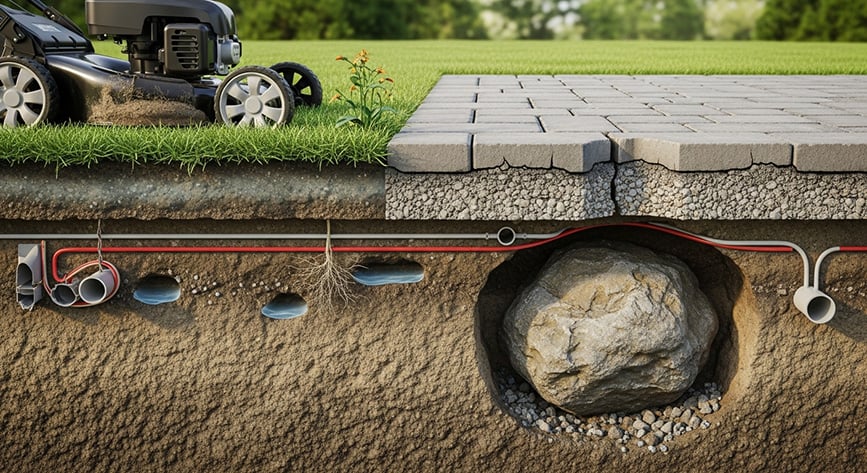
| Even experienced crews can be surprised by what’s underground: variable fill, soft pockets, shallow bedrock, old construction debris, or layered soils that behave differently when wet. Seismic Data Processing & Imaging Services help reduce uncertainty by turning subsurface vibration measurements into interpretable “images” and profiles of what’s below grade. |
| What it helps identify (practically) |
Depending on the method and site, seismic imaging can help characterize:
- Layering and depth to more competent material (e.g., firm native soil or bedrock)
- Soft/loose zones that may settle under patios, slabs, or retaining walls
- Variations in compaction across a site (useful where fill is suspected)
- Moisture-influenced weakness patterns (areas that behave like “sponges” after irrigation/rain)
- Slope or wall risk factors by highlighting weaker strata that may contribute to movement
|
| Why it matters for lawn care and hardscapes |
- Better equipment decisions: If the subsurface is consistently soft or holds water, you may prioritize lighter equipment, wider tires, track systems, or adjusted maintenance timing to avoid rutting and compaction.
- Smarter base design: For patios, walkways, and driveways, seismic insights can guide how aggressively you excavate and rebuild the base, where you need geogrid stabilization, and how thick the aggregate layer should be.
- Drainage planning that matches reality: Instead of guessing where water “should” go, subsurface mapping helps align grading and drainage features with how water and soil layers actually behave.
- Fewer callbacks and repairs: Hardscape failures (settling, cracking, heaving) often start with unseen conditions. Imaging helps catch them early—before installation.
|
| Typical service flow (high level) |
- Data acquisition (field measurements)
- Seismic data processing (noise reduction, filtering, velocity analysis)
- Imaging/inversion deliverables (subsurface profiles/maps)
- Actionable recommendations tied to construction and equipment choices
|
| This fits especially well for projects with a history of settling, uncertain fill, mixed soils, drainage complaints, or higher-stakes structures like retaining walls and driveways. |
| Hardscape Projects: The Influence of Soil and Site Conditions |
| Hardscape projects, including patios, walkways, retaining walls, and driveways, require significant planning and consideration of the soil and site conditions to ensure structural integrity and aesthetic appeal. |
| 1. Soil Conditions and Foundation Stability |
The foundation is one of the most important aspects of any hardscape project. The soil conditions directly beneath the surface determine how stable the foundation will be and whether the hardscape will settle or shift over time.
- Clay soils: Expand/contract with moisture changes, causing shifting and settling. Prevent issues with proper compaction, reinforcement, and well-built base layers (often gravel and stabilization techniques).
- Sandy soils: Drain well, but can lack cohesion and erode. Proper compaction and a well-structured base layer are essential to prevent shifting.
- Loam soils: Generally ideal balanced drainage and stability, often providing a strong base for many installations.
|
| 2. Drainage and Hardscape Design |
Proper drainage is crucial. Poor drainage can lead to erosion, pooling water, and long-term damage.
- Clay/compacted soils: Retain moisture, increasing the risk of standing water—often requiring grading, drains, or permeable solutions.
- Sandy soils: Drain quickly but can erode—may require stabilization measures to control runoff.
|
| 3. Selecting Hardscape Materials for Soil Conditions |
Material selection should match soil behavior.
- Concrete: Durable but vulnerable to cracking if soils shift; reinforcement and joints become more important on expansive soils.
- Pavers and natural stone: More flexible; often better for soils prone to movement.
- Gravel and loose materials: Great for infiltration and drainage support, but may need edging/stabilization to prevent migration.
|
| 4. Retaining Walls and Soil Pressure |
Soil type behind the wall affects pressure and drainage needs.
- Clay soils: Higher pressure and moisture retention walls need strong reinforcement and reliable drainage behind the structure.
- Sandy soils: Can still exert pressure and wash out; the design must manage runoff and prevent erosion behind the wall.
|
| Conclusion |
Soil and site conditions are not secondary considerations in lawn care and hardscape projects—they are the foundation of success. Whether selecting the right equipment for mowing, aerating, or irrigating, or choosing the right materials and base design for patios, retaining walls, and driveways, understanding the subsurface is key to long-lasting performance.
By combining practical site awareness (soil type, drainage, compaction, slope, moisture) with tools like Seismic Data Processing & Imaging Services, homeowners and contractors can reduce guesswork, prevent costly failures, and build landscapes that remain stable, functional, and attractive for years to come.
|