 |
| Introduction |
In the landscaping business, time is money, and equipment failure does not wait for a convenient moment. Whether you are right in the middle of a commercial property overhaul or wrapping up a residential lawn care schedule, a broken mower belt or a cracked fuel line can bring your entire operation to a grinding halt. The cost of downtime goes far beyond a missed appointment; it affects your reputation, your cash flow, and your client relationships.
The most successful landscaping professionals understand that a well-stocked parts inventory is not an expense; it is an investment in reliability. Just as a savvy homeowner might research services like air duct cleaning Spanish Fork before a seasonal rush to stay ahead of maintenance needs, smart landscapers proactively manage their equipment's health by keeping critical spare parts on hand. This article will walk you through the essential spare parts every landscaper should stock, organized by equipment category, so you can minimize downtime and keep every job running smoothly.
|
| Section 1: Mower Parts That Belong in Every Trailer |
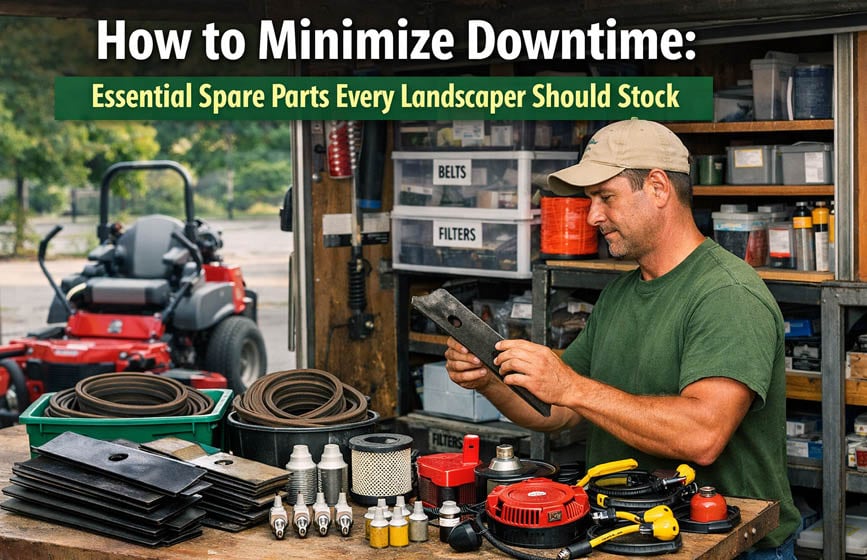
Your mowers are the backbone of your landscaping business, and they also carry the highest risk of unexpected failure. Keeping a targeted selection of mower-specific parts on hand means the difference between a five-minute roadside fix and losing an entire day of work.
Drive Belts and Blade Belts
Belts are among the most common failure points on walk-behind and zero-turn mowers alike. They stretch, crack, and snap under heavy use, especially during peak season when equipment rarely gets a rest. Stock at least one or two spare belts that match the models in your fleet. Label them clearly, and replace belts during scheduled maintenance rather than waiting for a break to force the issue.
Mower Blades
Blades dull quickly, especially if your crews are working on properties with sandy soil, rocks near fence lines, or debris-heavy turf. A dull blade tears grass rather than cutting it cleanly, leading to browning and unhealthy turf; a damaged blade can create vibration that wears out spindle bearings prematurely. Keep a full set of replacement blades for each mower model you operate, and build blade sharpening and rotation into your weekly routine.
Spindle Bearings and Spindle Assemblies
Spindle bearings are often overlooked until they fail with a loud grinding noise mid-job. A failed spindle brings the entire deck to a halt. Stocking a spare spindle assembly for your most-used machines ensures that what could be a multiday repair becomes a quick swap performed in the field or back at your shop.
Air Filters and Fuel Filters
Clean air and clean fuel are non-negotiable for engine health. Clogged air filters reduce performance and can cause engines to overheat; dirty fuel filters lead to hard starts and power loss. These are inexpensive parts with a significant impact on performance. Keep a generous supply of both for every engine type in your fleet.
|
| Section 2: Small Engine and Handheld Equipment Essentials |
Handheld equipment, including trimmers, blowers, edgers, and chainsaws, sees intense daily use and suffers from high vibration, heat exposure, and occasional operator mishandling. These tools might be smaller than your ride-on mowers, but their downtime can significantly slow production on a busy job site.
Spark Plugs
A fouled or worn spark plug is one of the most common causes of hard-starting engines. Fortunately, spark plugs are cheap and easy to replace. Keep a variety of plugs that match your two-stroke and four-stroke equipment. Replace them on a scheduled basis rather than when the engine refuses to start.
Trimmer Line and Spool Heads
Running out of trimmer line mid-job is an avoidable problem that slows crews down more often than it should. Stock bulk trimmer line in the diameter your equipment requires, and keep pre-loaded spare spool heads for each trimmer model. Some crews waste twenty to thirty minutes per day just managing trimmer line; the right inventory strategy eliminates that loss entirely.
Recoil Starters
Recoil starters take a beating over time. Springs break, cords fray, and pawls wear out. A recoil starter failure means a tool that simply will not start, period. For high-use equipment, keep a spare recoil starter assembly on hand. They are relatively affordable and quick to swap in the field with basic tools.
Fuel Lines and Primer Bulbs
Small fuel lines and primer bulbs on two-stroke equipment dry out, crack, and split, especially in heat. These tiny components cause a disproportionate number of no-start issues. A small assortment of fuel line lengths, primer bulbs, and fuel line clamps takes up almost no space but saves tremendous time on the job.
|
| Section 3: Irrigation and Ground Care Equipment Parts |
Many landscaping businesses have expanded beyond mowing and trimming into irrigation installation, repair, and seasonal maintenance. Ground care equipment such as aerators, tillers, and sod cutters also presents unique parts challenges. Planning ahead for these systems is just as important as maintaining your cutting equipment.
Irrigation Heads and Fittings
Sprinkler heads get damaged by mowers, foot traffic, and freeze-thaw cycles on a regular basis. Stocking a variety of pop-up heads, rotary heads, and basic PVC fittings means you can address a client's irrigation issue during a routine visit rather than scheduling a follow-up trip. Time saved on callbacks is time you can bill elsewhere.
Valve Solenoids and Pressure Regulators
Valve solenoids are electrical components that fail due to voltage spikes, water intrusion, and general wear. They are affordable, compact, and worth keeping in your service vehicle if you manage irrigation systems for clients. Pressure regulators also wear out over time and affect system performance in ways that are not always obvious until a client notices dry patches or flooding zones.
Aerator Tines and Tiller Tines
If your operation includes lawn aeration or soil tilling, keeping spare tines is essential. Tines wear down quickly in hard or rocky soil and can break entirely on impact with buried debris. A broken tine mid-aeration job leaves you with an incomplete service and a frustrated client. Check tine condition before every use and stock replacements accordingly.
Hydraulic Hoses and Fittings
For larger ground care equipment with hydraulic systems, hose failure can be a sudden and messy problem. While you may not stock every possible hose configuration, keeping a few high-pressure hydraulic hose repair kits on hand allows you to address common failures without a tow to the shop.
|
| Section 4: Organization, Tracking, and Smart Inventory Management |
Stocking spare parts only helps if you can find what you need quickly and know when to reorder. An unorganized parts bin is almost as bad as having no inventory at all. Building a simple but consistent inventory system pays dividends in speed and cost control.
Label and Categorize Everything
Use plastic bins or small drawer organizers to separate parts by equipment type or by part category, such as filters, belts, blades, and electrical. Label every bin clearly, and keep a printed parts list on the inside of your trailer door or tool cabinet so crew members can locate items without guessing.
Use a Reorder Threshold System
Set minimum stock levels for your most-used parts. For example, never let your belt inventory drop below two units per mower model, and never let spark plugs fall below a full box. When you pull the last unit from a bin, that triggers an immediate reorder. This simple discipline prevents the situation where a part runs out precisely when you need it most.
Track Your Failure Patterns
Keep a basic log of every repair you make, noting the part, the machine, and the date. Over a season, patterns emerge. If a particular belt fails every six weeks on a specific mower, that tells you to inspect that mower's pulley alignment, not just replace the belt. Data-driven maintenance reduces both parts costs and unplanned downtime significantly.
Establish a Trusted Supplier Relationship
Know your parts suppliers before you need them urgently. Build relationships with local dealers and online suppliers who offer fast shipping. Having a backup supplier for critical components means that even if your primary source is out of stock, you have a plan. Some landscaping businesses negotiate volume discounts with suppliers once they demonstrate consistent purchasing patterns.
|
| Conclusion and Call to Action |
Downtime is one of the most controllable costs in the landscaping business, yet it catches many operators off guard season after season. The solution is not complicated; it requires deliberate preparation, a well-stocked parts inventory, and a disciplined maintenance mindset.
Start by auditing your current fleet and identifying the parts that have caused delays over the past year. Then build your inventory from the ground up, starting with the highest-failure components covered in this article. Organize your storage system, establish reorder thresholds, and train your team on where parts are located and how to perform basic field repairs.
The landscapers who consistently win in this industry are not always those with the newest equipment; they are the ones whose crews never have to wait. When your equipment runs, your business grows. Take action this week by reviewing your parts inventory, identifying the gaps, and placing the orders that will keep your entire operation moving forward without interruption.
|